“Vortexes” are not just “woo woo” talk, they are based on electromagnetic principles. Granite belongs to a large family of rocks called granitoid, composed of quartz, alkali feldspar, and plagioclase. It is considered to be “paramagnetic,” meaning it is susceptible to the surrounding electromagnetic fields and thus, may have a soothing or calming affect on the human body. You may find that places that are considered to be “vortexes” like Mount Shasta or Sedona, etc., are rich in similar minerals.
In Central Texas Hill Country, numerous energy vortices connect underground within a rough triangular region between Austin, San Antonio and Llano, Texas. One of the largest outcroppings is called Enchanted Rock, a massive pink granite dome rising above Central Texas. This impressive location was supposedly used by indigenous tribes to gather in the past. This vortex energy spreads out south and eastwards from this special State protected Natural Area.
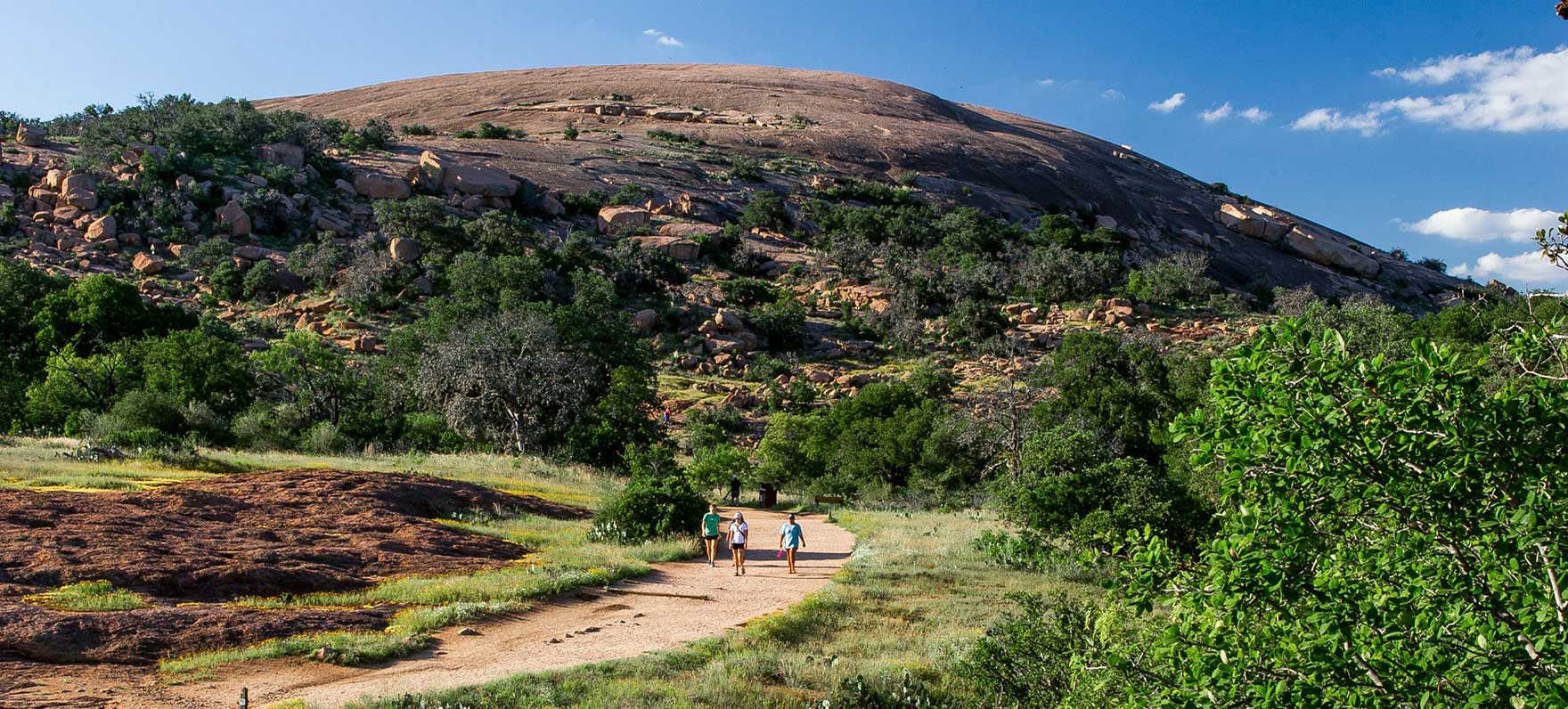
https://tpwd.texas.gov/state-parks/enchanted-rock
WATER!
The other critical element that adds to an energy vortex is water.
 Hill Country has been historically filled with thousands of natural springs. The energy flows through telluric Ley Lines that cross over the Edwards Aquafer, which is one of the most prolific aquifers in the world – and which spouts countless healing springs.
At the very center of this water energy vortex area lies the Texas Wine Trail between Johnson City and Fredericksburg. The Seed of Life Sanctuary is along this highway and at the very heart center of this zone. Our property is bounded on the west side by Historic Rocky Creek, a year-round spring fed creek (from at least three spring fork sources). We have been told, it is one of the few creeks in the area that has never gone dry even in severe droughts.
We welcome healers of all manners here to join in our quest to create Cosmic Christ Consciousness and a slice of Garden of Eden Heaven on Earth.
Property History
Archaeologists have found evidence of humans occupying parts of the Hill Country for 10,000 years! We have even found chipped limestone and arrowhead here. The land is naturally ample with wild deer, turkey, pecans, mesquite, fish and more (including snakes!). The hills are filled with ‘Edwards Chert,’ stone aka flint. Native Americans have loved the land and tribes were know to gather in the area for meetings. We have found arrowheads on property indicating indigenous usage.
German immigrants later came to the state of Texas in the 1800s, and many settled in Hill Country. The historic town of Fredericksburg is emblematic of this history. Many people there still speak German. In fact, there were so many German settlers in Texas, we have been told that the official state language was almost voted to be German!

Our piece of property has served the local community for years for herd grazing along the creek. The small hand-built rock building *which we estimate to date from the 1800s) on the highway sold local peaches, and we were told it potentially sold booze during prohibition years. (A prophetic place to run a sober-oriented community!!!) A house and petrol station (circa 1940s) were also on the land. We were told the gas station proprietor would put lanterns along the highway to help drivers safely find their way along this notorious curve on the road. The location was a welcome stopping point between Fredericksburg and Austin on the outskirts of Johnson City.

In later years, a Honky Tonk known as the Mermaid Club opened up on this site at the end of 1966. The opening act was the Texas Show Boys. There are ads that show they were still in business up until the 1970s. We were told that the site was burned down by an arsonist!
Rocky Creek experienced a major flood at one point. Parts of a broken-down bridge were in a twisted pile of rusted metal on the site when we acquired it. All of metal salvaged on site has been fully cleaned up and recycled.


We have since salvaged the two historic rock buildings on site and restored their roofs to protect against the ample rains in the area.
Our sanctuary was initially inspired by what Rabbi Dr. Gabriel Cousens created at Tree of Life in Patagonia, AZ. In addition we visited the Essene Monastery in Oregon, spoke with Leslie the Enchanted Garden in San Diego, and researched the writings and community from ancient writings such as Nag Hammadi Scriptures and the Dead Sea Scrolls, and Modern interpretations such as those created by Edmond Bordeaux Székely, translator of the Essene Gospel of Peace.
Our land has been blessed and Dedicated to our Lord Yashua Hamashiach (Jesus Christ). As you drive down Highway 290 at night, you will see a small neon cross lighting your Way safely down the highway.
Sacred Sites Signpost
Some metaphysical enthusiasts suggest that there are areas situated on ley lines, which are believed to be energy pathways connecting sacred sites worldwide. When anand first learned about the Energy Vortices (https://seedoftexas.com/vortex/) connecting underground within a rough triangular region between Austin, San Antonio and Llano, Texas, she knew there had to be some kind of marker to signify the spot. She was inspired by a few nearby signs, the Texas Olive Company, Luckenbach, and the classic Jacob’s Well sign. This was exactly what the Seed of Life needed to put it ‘on the map.’
So anand began to make a list of places that represented the best historic or metaphysically significant vortices on planet earth. The concept was drawn up and mileage calculated. Jamie ‘Fawn” Bihl lent a steady hand in the final executions of a few signs as well as helping to get it screwed into place.
Here is what you will find on our sign and their accompanying significance. Obviously, there are many other appropriate locations that did not make the final cut, but I only had 7′ of telephone pole to use and I wished to have diversity of geographic locations.
Rupes Nigra – 3,854 miles
A mysterious “Black Rock” in Roman mythology, associated with the divine and considered significant in ancient Roman spirituality. A magnetic “black rock” is also believed to be located at the North Pole. It was described by Mercator as 33 “French” miles in size, and claimed it explained why compasses point north. Jules Verne mentions it in The Adventures of Captain Hatteras.
Garden of the Gods, Colorado – 696 miles
Located in Colorado Springs, Colorado, these stunning red sandstone rock formations are a popular destination for outdoor enthusiasts and nature lovers. The red rocks were considered sacred by Native American cultures and a place for spiritual contemplation.
Nikola Tesla conducted groundbreaking experiments in Colorado Springs in the early 20th Century due to the area’s high altitude, low air pressure, and dry climate, which he believed were ideal conditions for his experiments in etheric wireless power transmission and electricity research.
Tulum, Mexico – 980 miles
Home to Mayan ruins overlooking the Caribbean Sea on the eastern coast of the Yucatan Peninsula, it holds cultural and historical significance, reflecting ancient Mayan spirituality and architecture. It dates back to the late Postclassic period, around the 13th century AD
Mount Shasta, Northern California – 1,526 miles
Regarded as a mystical and spiritually charged mountain, it attracts seekers of enlightenment and metaphysical experiences. It is believed that angelic interdimensional beings like to hang out there! And no wonder, Mount Shasta is the source of several stunning gushing headwaters, including the Sacramento River, the McCloud River, and the Shasta River, making it a significant contributor to the water supply in Northern California.
Nag Hammadi, Egypt – 7,364 miles
I chose Nag Hamaddi Library in Egypt over Alexandria, Giza Plateau, Luxor or ancient Karnak, because of its significance to Modern Chirstianity. Karnak was primarily a religious and ceremonial complex located in Thebes, Egypt and the Nag Hammadi Library was a half days walk from that vicinity. The Library was most likely left by a group of monks in the early 4th Century to preserve the books during a time of theological controversy in the early Christian church. The texts were protected from destruction or suppression by religious authorities for a time such as ours.
Mount Mitchell, North Carolina – 1015 miles
Some believe that Asheville and the surrounding mountains, including Mount Mitchell, possess energy vortexes or areas with heightened spiritual energy. Lush forests, pristine rivers, and scenic mountains of the area, including highest peak in the eastern United States, inspire connection to nature and G*D. The region has a rich history of Native American cultures, including the Cherokee Nation.
Sedona, Arizona – 1,890 miles
Stunning red rock formations similar to those found in Utah’s National Parks, were primarily shaped by millions of years of geological processes. The rocks are primarily composed of red sandstone and limestone layers, which were deposited during the Permian period around 250 million years ago. Sedona has become famous for its energy vortexes, it’s a destination for individuals seeking healing, spiritual growth, and metaphysical experiences.
Glastonbury, England – 4,856 miles
In Celtic and pre-Christian mythology, Avalon was sometimes referred to as “The Isle of Apples” and was seen as a sacred place associated with the Otherworld, a realm of supernatural beings and divine energies. Glastonbury Abbey, was built on this site during the Middle Ages. The abbey was founded in the 7th Century. It is believed to be the burial place of King Arthur, making it a site of Arthurian legend and spiritual pilgrimage and also the site where Joseph of Arimathea is said to have brought the Holy Grail.
Calico Basin, Nevada – 1,057 miles
The Calico Basin is in Red Rock National Conservation area just west of Las Vegas. There are ancient petroglyphs, and a natural spring in the area bringing life to the desert and a more recently installed giant spiral labyrinth which was the inspiration for our labyrinth.
Mount Kailash, Tibet – 8,200 miles
Mount Kailash is believed to be the abode of Lord Shiva in Hinduism, a place where the Buddha is said to have practiced, and an important spiritual destination for Jain pilgrims. The mountain itself is known for its distinctive shape and the challenging pilgrimage route that circumambulates it, known as the Kora. Many pilgrims perform the Kora, which is believed to bring spiritual purification and blessings.
Machu Picchu, Peru – 4,441 miles
The 15th Century Inca citadel perched high in the Andes Mountains of Peru is renowned for its remarkable architecture and breathtaking panoramic views. It is often referred to as the “Lost City of the Incas,” and is an archaeological marvel and UNESCO World Heritage Site
Grotto de la Sainte-Baume – 5,459 miles
Legend has it that Saint Mary Magdalene, along with her companions Mary the mother of James and Mary Salome, arrived on the shores of what is now Saintes-Maries-de-la-Mer, a town in the Camargue region of southern France, after a journey by sea. The town hosts an annual pilgrimage, “Pèlerinage aux Saintes-Maries-de-la-Mer.”
There are several other sites in the area dedicated to her, the Basilica of Saint-Maximin-la-Sainte-Baume, Basilica of Mary Magdalene, Vézelay, and Église Sainte-Madeleine, Aix-en-Provence. The “Grotto” is a cave sanctuary traditionally believed to be where Saint Mary Magdalene spent her last years in contemplation, attracting spiritual seekers.
Mount Carmel, Israel – 7,199 miles
Mount Carmel is in northern Israel along the Mediterranean coast. At one point, it was called the “mount and temple of Zeus” in the Periplus of Pseudo-Scylax. Pythagoras’ visited to the mountain as one of the most sacred and revered places of his time. It is currently home to the Bahá’í World Centre and the Shrine of the Báb.
For Christians, it’s associated with the prophet Elijah, who is believed to have confronted the prophets of Baal on the mountain. Mount Carmel is recorded to be the center of the Northern Essene community that was supported by the Nazarene kibbutz, a day’s walk away, roughly 20 miles away. It is very possible that this is where Yashua (Jesus) may have studied to become a rabbi in his unknown years. In the Middle Ages, it became associated with the Carmelite Order, and the Stella Maris Monastery was established.